
Ask any teacher what makes school trips to Barcelona work and you will hear the same answer: you can walk through 2,000 years of history in an afternoon. Roman walls, a medieval cathedral with thirteen geese, a square still marked by a 1938 bombing and the most famous unfinished church in the world, all within a few meter stops.
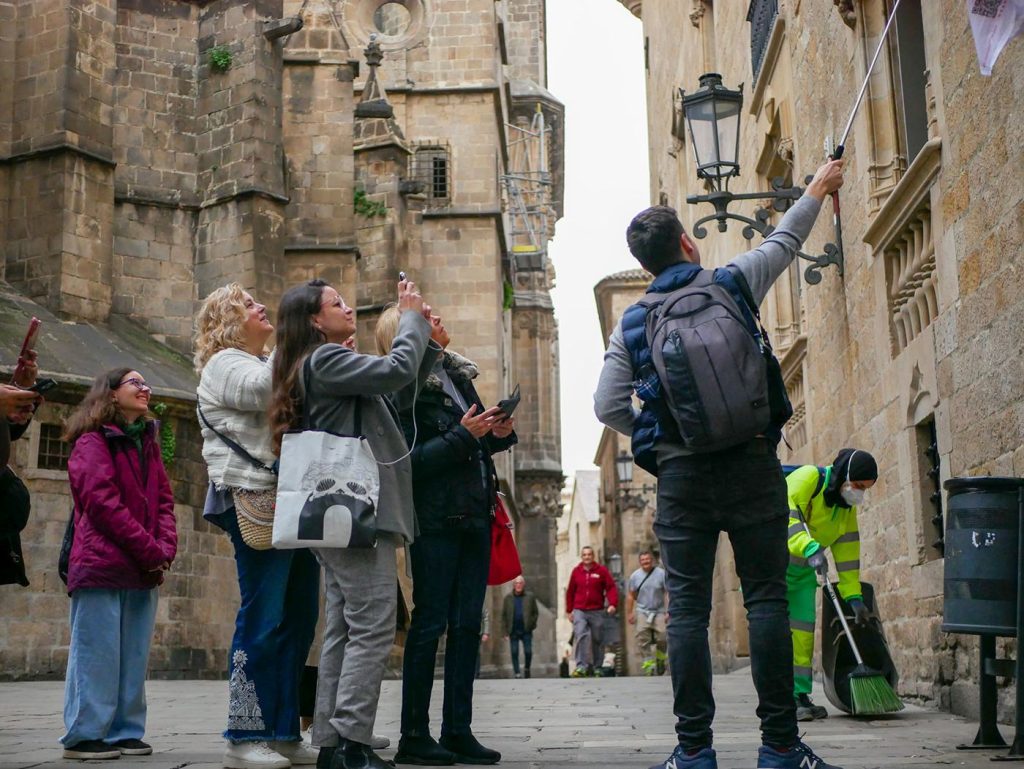
We guide school groups through these streets every week, so this itinerary is built from what actually works with students: short stops, real stories and a reason to look up from the phone. Or better, a reason to look through it.
Why Barcelona is perfect for school trips
- History you can touch. Students don't read about Roman Barcino: they put their hand on its walls.
- Walkable. The Gothic Quarter is compact, so the group spends its time learning, not on a coach.
- Curriculum links everywhere. Romans, the Middle Ages, the Jewish quarter, 1714, the Civil War and Modernisme.
- Easy to combine. The high-speed train reaches Madrid in about two and a half hours.
Day 1 · The Gothic Quarter: Romans, kings and legends
The best way into the Gothic Quarter It is on foot and in a circle. Our route starts next to the cathedral, in Plaça Garriga i Bachs, and takes about two hours.
- Casa de l'Ardiaca. Look at the letterbox by the door: swallows and a tortoise carved in stone. The swallows stand for the speed justice should have, the tortoise for the speed it actually has. Students love it, lawyers less so.
- Barcelona Cathedral and its geese. In the cloister live thirteen white geese, one for each year of Saint Eulàlia, the city's young patron saint martyred by the Romans. Yes, real geese. In a cathedral.
- Plaça del Rei. The heart of the medieval Crown of Aragon. Tradition says the Catholic Monarchs received Columbus here after his first voyage. Ask your students what they think he brought back.
- Plaça de Sant Jaume. Once the Roman forum, today the square where the Catalan government and the city council face each other across the cobbles. Politics in Barcelona has always been a matter of who looks out of which balcony.
- Pont del Bisbe. The ‘medieval’ bridge was actually built in 1928. Look underneath for a skull pierced by a dagger. Legend says whoever pulls out the dagger will bring disaster on the city. Nobody has tried. Yet.
- Plaça de Sant Felip Neri. The quietest square in the old town, with walls still scarred by a 1938 bombing during the Spanish Civil War that killed dozens of people, many of them children. A powerful stop for history classes.
- The Call, the Jewish quarter. A thriving community until the attack of 1391 that destroyed it. Its narrow streets tell a story of coexistence and loss that every student should hear.
Along the way, our guides add the stories that never make it into textbooks: a medieval playboy, the house of the city's executioner, Barcelona's own version of Romeo and Juliet and the French occupation during the Napoleonic wars.
Day 2 · 1714 and the Born
Cross Via Laietana into the Born. At the El Born Center de Cultura i Memòria, under an iron market hall, lie the excavated streets of the neighborhood destroyed after the siege of 1714, the end of the War of the Spanish Succession. Students walk above real houses, real streets and real kitchens of 300 years ago. Finish at Santa Maria del Mar, the church built by the sailors and porters of the neighborhood, stone by stone.
Day 3 · Gaudí and Modernisme
Walk up Passeig de Gràcia, where Barcelona's wealthy families competed to have the most daring façade, and finish at the Sagrada Familia, which reached its final height of 172.5 meters in 2026. If the group wants to go inside, book group tickets on the official website as early as possible: they sell out long before individual tickets. If they are gone, the façades are a lesson in themselves.
Adding Madrid: two days in the capital
Many school trips combine Barcelona with Madrid, and the contrast is the lesson: the Mediterranean trading city against the capital of an empire. Our Madrid route runs through the Habsburg quarter, from Puerta del Sol to the cathedral, in about an hour and a half.
- Puerta del Sol. Find the Kilometer Zero plaque, the starting point of Spain's radial roads. Above it, the Casa de Correos clock, to which the whole country eats twelve grapes every New Year's Eve. And remember 2 May 1808: some of the fiercest fighting of the uprising against Napoleon's troops took place right here.
- Main Square. Today it is coffees and selfies. Before, it was markets, bullfights, royal ceremonies and the autos-da-fé of the Inquisition. The square burned three times. And the horse in the middle? For years, people said the statue was cursed, because bird skeletons kept falling out of it. The truth: birds flew in through the horse's mouth and couldn't find the way out.
- San Miguel Market. An iron-and-glass market since 1916, one of the last of its kind in Madrid. Perfect for a lunch break that is also an architecture lesson.
- Plaza de la Villa. Madrid's old town hall square. Legend says King Francis I of France was held prisoner in the Torre de los Lujanes after the Battle of Pavia in 1525. Just around the corner, Calle del Codo, where Quevedo traded insults with his neighbors.
- Royal Palace. Built after the old Alcázar burned on Christmas Eve 1734. More than 3,400 rooms: spend one night in each and you would stay almost a decadent. Legend says Philip V, in his darkest years, believed he was a frog.
- Almudena Cathedral. Started in 1883 and only finished in 1993. Proof that the Sagrada Familia is not the only slow project in Spain.
Practical tips for teachers on school trips to Barcelona
- Book the Sagrada Familia and the Royal Palace first: group slots go long before individual tickets.
- Keep stops short and frequent. Teenagers follow a story better than a lecture.
- In June and July, walk in the morning and plan indoor visits for the afternoon.
- Leave a free half-day in each city. Groups always run behind schedule.
- Give students a challenge at each stop: find the tortoise, spot Kilometer Zero, count the geese.
How HistARy works with schools and agencies
HistARy combines a local guide with an augmented reality app: students see the city as it was, and the stories are told with humor so they stick. Teachers and tour leaders tell us the same thing: it fits the itinerary without changing the operation, and the group comes back talking about history. We work in Barcelona, Madrid, Valencia, Girona, San Sebastián and London, and we can confirm groups with seven days’ notice.
Ask for a proposal for your group: contact HistARy Educational Tourism
School trips to Barcelona: quick answers
Three days cover the Gothic Quarter, the Born and Gaudí. Add two more to include Madrid.
Yes. The stories adapt to every age: younger students love the geese and the tortoise, older ones the 1714 siege and the Civil War.
By high-speed train, in about two and a half hours.
No. It is an outdoor walking route; only the monuments you visit inside need tickets.