The story of the round Earth: knowledge older than the Internet
The story of the round Earth: knowledge older than the Internet
The story of the round Earth: knowledge older than the Internet
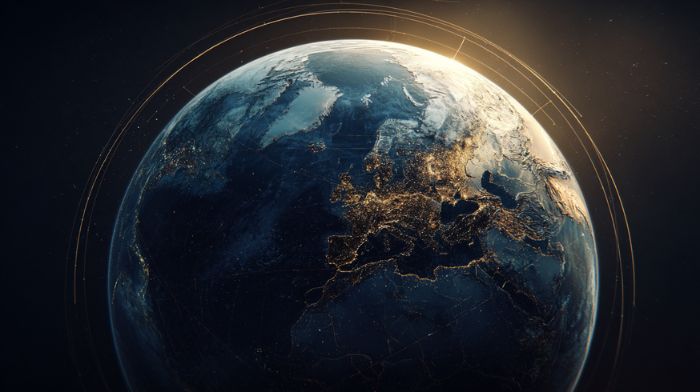
When someone mentions the current discussions about whether the Earth is flat or spherical, many imagine a modern debate fueled by social media. But the history of the round Earth It began long before satellites, GPS, or photos from space. What's surprising is not that flat-Earthers exist today, but that this idea was dismissed with scientific arguments more than 2,000 years ago, without modern technology, telescopes, or instant access to information.
The Earth's sphericity is not a recent belief or a contemporary scientific imposition; it is the result of knowledge accumulated, measured, compared, and validated over millennia. Understanding the history of the round Earth It is essential to understand why, even in the 21st century, certain denialist discourses reappear.
Since when have we known the Earth is round: the story of the round Earth before the Internet
Long before the digital age, thinkers in antiquity had already reached a conclusion that remains evident today: the Earth is spherical. And they didn't assert this through intuition, but through direct and repeated observation.
Ancient evidence of the history of the round Earth
The ancient Greeks, especially from the 5th century BC onwards, already had solid evidence:
- Shadows in lunar eclipses: the Earth's shadow projected onto the Moon was always circular.
- Changing constellationsWhen traveling south, stars invisible from higher latitudes appeared.
- Ships sailing away on the horizonFirst the hull disappears, then the mast, which only fits on a curved surface.
These basic observations already made it impossible for the Earth to be flat. However, there was one thinker who took this research to the next level, becoming a pillar of the history of the round EarthEratosthenes.
Eratosthenes: the historical experiment that disproves any flat Earth theory
In the 3rd century BC, Eratosthenes of Cyrene—mathematician, geographer, and director of the Library of Alexandria—conducted one of the most ingenious and elegant experiments in the history of science.
Their goal wasn't to prove that the Earth was spherical. That was already taken for granted. Their goal was measure its size.
How Eratosthenes measured the Earth step by step
- I knew that in Syene (present-day Aswan), during the summer solstice, the sun fell exactly vertically:
- There were no shadows
- The light illuminated the bottom of the wells
- On the same day and at the same time, in Alexandria, he placed a vertical pole.
- There, a shadow did appear.
- He measured its angle: about 7.2 degrees.
- He knew the distance between Siena and Alexandria: about 5,000 stadia.
- He applied proportionality:
- if 7.2° → 5,000 stadia
- then 360° → 250,000 stadiums
His calculation of the Earth's circumference turned out to be incredibly accurate.
Why this experiment is an essential part of the story of the round Earth
The experiment only makes sense on a spherical Earth.
On a flat Earth:
- the shadows would have the same inclination
- The sun's rays would not arrive from different angles
- Differences in latitude would not generate measurable variations
Eratosthenes left behind empirical and replicable evidence that is still taught in schools and universities today.
Ancient evidence that still stands: the story of the round Earth in everyday practice
History is not limited to the theories of isolated thinkers. history of the round Earth It was reinforced over centuries by:
- navigators who observed the curvature of the horizon
- astronomers who documented the displacement of constellations by latitude
- mathematicians who incorporated sphericity into geographical models
- travelers who experienced changes in the sun's shadow, the length of the day, or the position of the stars
None of this has been refuted in 2,500 years. What we do today is exactly the same thing… with more precise instruments.
The medieval myth: one of the most widespread falsehoods in the history of the round Earth
A widely held idea among modern flat-earthers is that "people used to believe the Earth was flat" and that the sphere is a modern invention.
Not only is it false: it's a myth invented in the 19th century.
What the Middle Ages really said about the history of the round Earth
In the Middle Ages:
- They studied texts by Aristotle, Pliny, Ptolemy, and others
- Universities taught spherical astronomy
- Intellectuals accepted the roundness of the Earth as a known fact
Medieval authors such as Isidore of Seville, Bede the Venerable, or Thomas Aquinas never defended a flat Earth.
How the modern myth about the flat-earth Middle Ages was born
It was created by 19th-century writers to ridicule the past, especially the Church, portraying it as an enemy of scientific knowledge.
There was never an officially flat-Earth Middle Ages.
It is a historiographical myth, not a fact.
Copernicus: a milestone in the history of the round Earth… but not because of its shape
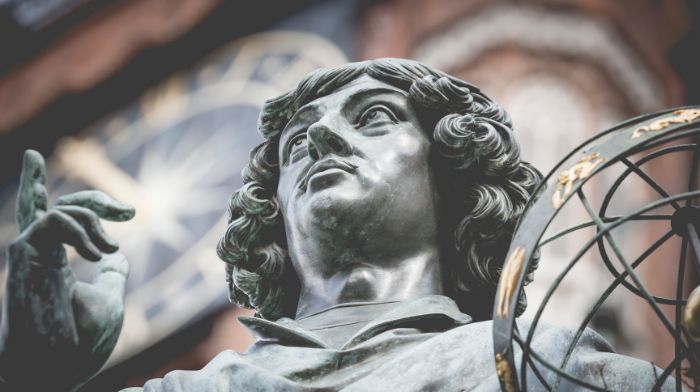
Nicolaus Copernicus revolutionized our view of the cosmos in the 16th century. But not because he defended a round Earth: that was already clear.
His revolution consisted of something else: moving the Earth from its pedestal.
- The Earth was not the center of the universe.
- We did not occupy a privileged position.
The debate was not geometric, but metaphysical and theological.
The history of the round Earth It was already more than established.
Christopher Columbus: the most famous popular lie about the history of the round Earth
It is often said that Columbus "proved" that the Earth was spherical.
That's also false.
In the time of Columbus:
- The Earth was already considered round.
- The real debate was the size of the planet
Columbus believed the Earth was smaller than it actually is. His critics—who were right—calculated a larger size and opposed his plan.
Columbus did not fight against flat-earthers.
He fought against mathematicians who knew more than he did.
Why flat-earth theory is making a comeback in the 21st century: history, society and critical thinking
The resurgence of flat-Earth theory has nothing to do with a lack of evidence. Evidence abounds. The problem is social, not scientific.
Distrust in institutions
Many people view governments, universities, and scientists as manipulative entities. The idea of a grand global conspiracy becomes emotionally appealing.
Algorithms and virality
Social media rewards controversial and simplistic content.
Complex ideas are expensive, conspiracies are consumed quickly.
Identity and belonging
The flat-earth belief functions like an exclusive club where its members feel they possess a hidden truth that others are unaware of.
Lack of historical education
Not understanding how knowledge is built over time leads to confusing skepticism with denialism.
The history of the round Earth It demonstrates that knowledge is built by accumulating observations, not conspiracies.
Flat Earth theory and denial of the past: a fight against 2,000 years of science
Doubt is healthy. Questioning is necessary.
But denying centuries of reasoning is not critical thinking; it is historical ignorance.
Flat-Earthism does not only contradict NASA or modern science.
Contradicts:
- to Eratosthenes
- to medieval astronomers
- to ancient navigators
- to classical mathematicians
People who, without modern technology, understood the world more accurately than those who today deny the evidence from a mobile phone with GPS.
The story of the round Earth as a defense against disinformation
At HistARy we believe that history is an essential tool for understanding the present.
The history of the round Earth It teaches us that:
- Knowledge does not arise from nothing
- Scientific theories evolve, are corrected, and are perfected.
- Errors are detected thanks to evidence, not opinions.
- The great intellectual revolutions happened in real cities, with real human beings.
Understanding how we know what we know is as important as the knowledge itself.
Book your self-guided tour now at HistARy.es
If you want to understand:
- How science was built
- Why history matters today more than ever
- how was it born history of the round Earth
- and what it teaches us about critical thinking and conspiracies
Discover our self-guided tours at:
https://histary.es
Living history. Science in motion. Critical thinking in motion.
-
 Harry Potter in London: real locations where magic meets historyFebruary 26, 2026
 -
Chinese New Year 2026: History, Traditions and Meaning | HistARyFebruary 26, 2026
-
The Earth has been round for 2,000 years: history proves it better than the internet.January 20, 2026
-
To return or not to return? The historical dilemma of diasporas (and what the current Venezuelan one teaches us)January 9, 2026
-
Kings who died in the most absurd ways in historyDecember 29, 2025
-
The fire at the Alcázar of Madrid: it changed the city forever: Was Philip V to blame?November 20, 2025
-
Argentina: from world power to economic meme (and back again)November 12, 2025
-
Calle del Codo and the duels in the Madrid of the Habsburgs: history, Quevedo, and secrets you'll discover on our tour.October 22, 2025
-
Spain in Shakespeare's universe: more than a Castilian accentOctober 5, 2025
-
Why are self-guided AR tours the future of cultural tourism?September 14, 2025