
It's the night of October 31st. In London, a group of costumed children knock on a door. In Barcelona, the smoke from roasted chestnuts wafts from a street stall. And in Mexico City, a family traces a path of orange petals to guide their deceased loved ones home. Halloween and Day of the Dead seem like opposite holidays, but they share roots, a calendar, and even recipes.
Three countries. Three ways of looking at death. And one same question: how do we remember those who are no longer with us?
If you coordinate study trips or teach, this guide is useful in two ways. First, to understand the history. Second, to prepare your students before traveling to Europe in the fall.
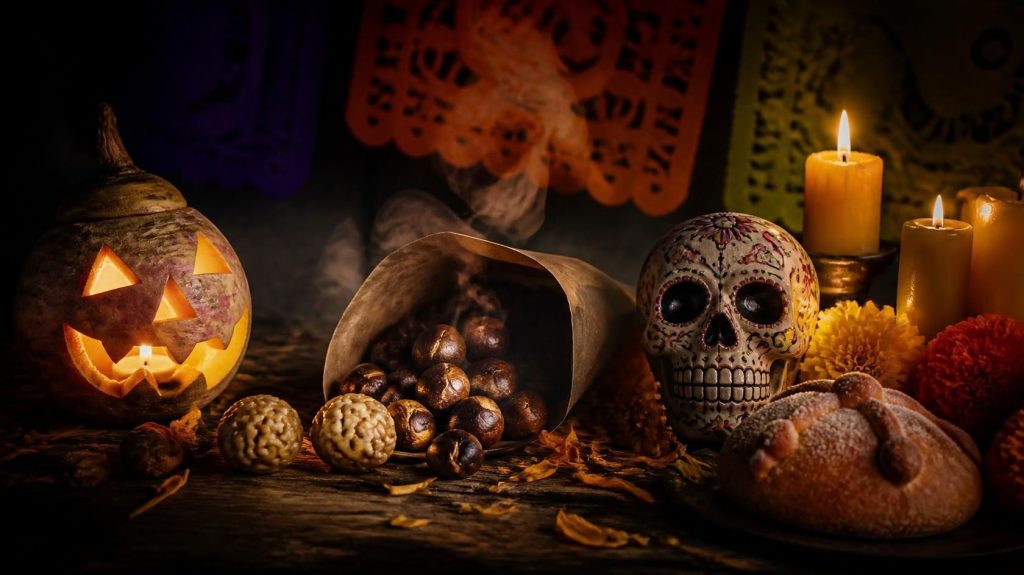
Halloween and Day of the Dead: one same origin, three paths
Over 2,000 years ago, the Celtic peoples celebrated Samhain, which means "end of summer." It marked the end of the harvest and the arrival of winter. They also believed that on this night the boundary between the living and the dead became thinner.
Centuries later, the Church established its own calendar. In the 8th century, Pope Gregory III dedicated a chapel in St. Peter's Basilica to all saints on November 1st. Later, in 837, Gregory IV extended the feast to the entire Church.
The eve of the holiday became known as All Hallows' Eve, the night of all saints. Over time, the name was shortened to Halloween. And November 2nd was reserved for praying for the dead.
When the Spanish arrived in the Americas in the 16th century, they brought with them the celebrations of All Saints' Day and All Souls' Day. There they encountered the Mexica rituals dedicated to death. From this blend was born the Day of the Dead, which UNESCO describes as a fusion of pre-Hispanic rites and Catholic festivities.
That's why Halloween and Day of the Dead fall on the same dates. They share the same calendar, but have very different characteristics.
United Kingdom: From carved turnips to Bonfire Night
In Scotland and Ireland, children would go from house to house in autumn dressed in costumes. They would sing or recite a poem in exchange for food. This custom was called guising, of disguise, "costume".
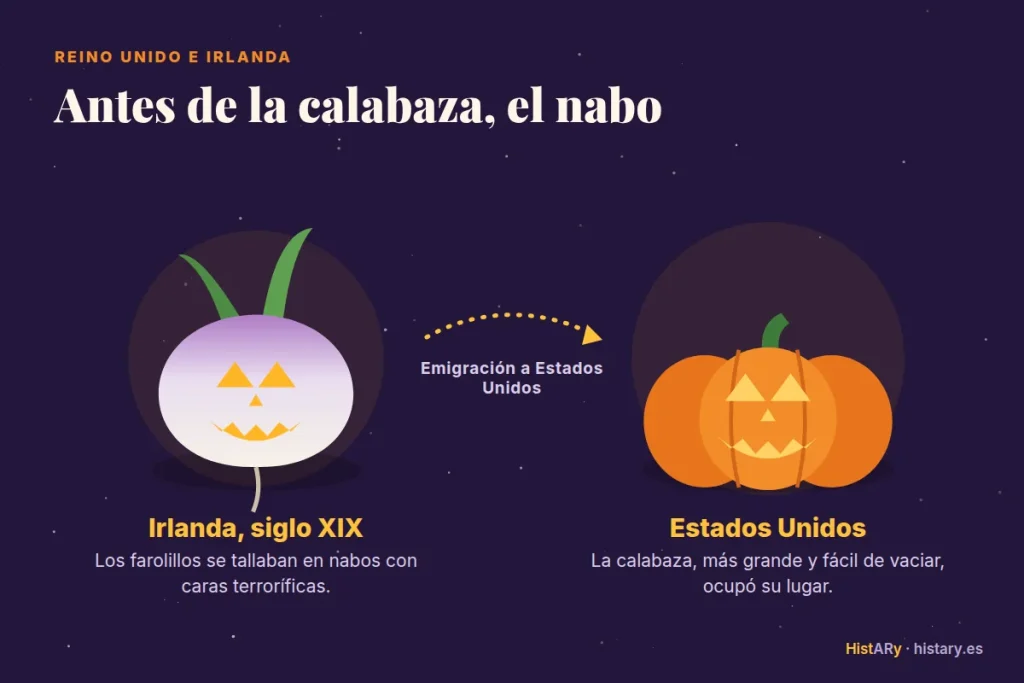
And the pumpkin? Here's the surprise. In 19th-century Ireland, lanterns were carved from turnips, with terrifying faces. When Irish and Scottish immigrants arrived in the United States, they discovered that pumpkins were larger and easier to hollow out. Thus, Halloween returned to Europe with an American twist.
Meanwhile, in England there was another tradition: the souling. On November 2nd, the children were asking for some small bread rolls called soul cakes. In return, they prayed for the dead of the family that gave them the money.
But if you ask an Englishman about the great night of autumn, they might mention November 5th. On that day in 1605, Guy Fawkes was arrested with the barrels of gunpowder he planned to use to blow up Parliament. Since then, Bonfire Night has been celebrated every year with bonfires and fireworks.
If you travel to London during those days, the sky fills with rockets. And if you want to discover the city with different eyes, in Our tours of London The story literally jumps off the mobile phone screen.
Does your trip include Scotland? We recommend our Edinburgh guide like a local, with cemeteries, legends, and dark alleyways.
Spain: All Saints' Day, Don Juan Tenorio and the Castanyada
In Spain, November 1st is a national holiday. Many families visit cemeteries, clean graves, and bring flowers. It is a day of reflection, but also of family reunions.
Pastries also play a role. In much of the country, people eat huesos de santo (marzipan rolls filled with egg yolk cream) and buñuelos de viento (wind fritters).
And there is a theatrical quote that withstands the test of time: Don Juan Tenorio, José Zorrilla's play, which premiered in 1844, is traditionally performed around this time of year. This is no coincidence, as the drama ends among tombs, with talking statues and a seducer confronting the dead.
La Castanyada: chestnuts, panellets and bell trees
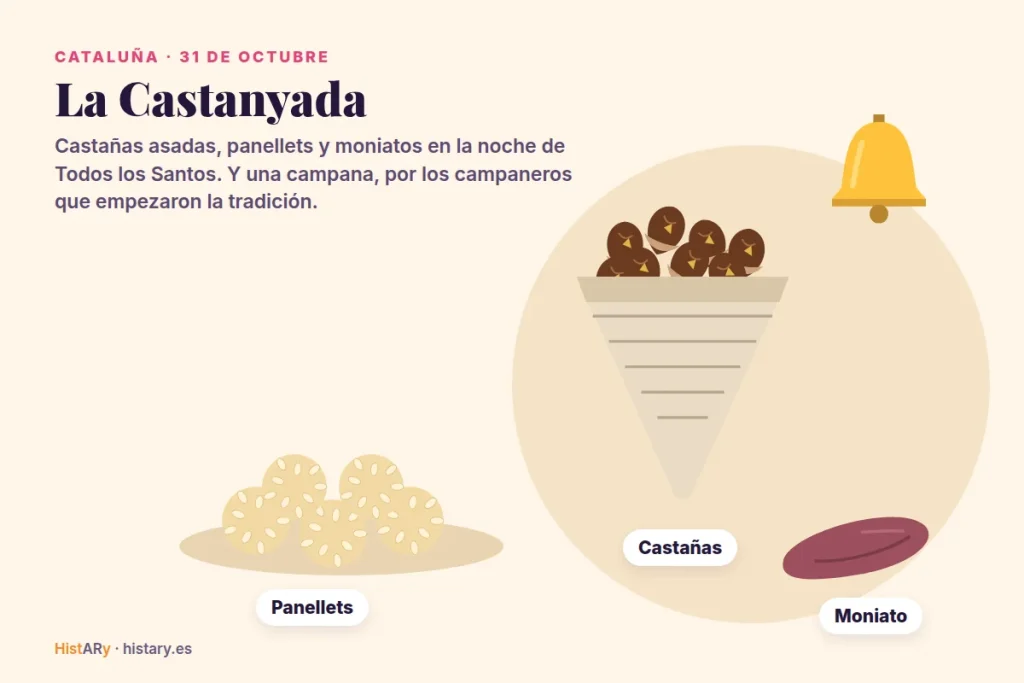
In Catalonia, the night of October 31st has its own name: La Castanyada. People eat roasted chestnuts, sweet potatoes (similar to Mexican sweet potatoes), almond and pine nut panellets, and toast with sweet wine.
Its origin? The most popular version tells of the bell ringers. On All Saints' Night, they would ring the bells for the dead for hours. To keep going, they ate chestnuts and drank wine. Little by little, the neighbors joined in, and the custom spread throughout the region at the end of the 18th century.
Panellets may also have originated as ancient funerary offerings. Because they lasted for many days, they were perfect for leaving in churches and on graves.
Today, in autumn, the chestnut trees They set up their stalls on the streets of Barcelona. And if your students are looking for something unsettling, the Poblenou cemetery awaits them. The Kiss of DeathA 1930 sculpture in which a winged skeleton kisses a young man. It is often cited as a possible inspiration for The Seventh Seal, by Ingmar Bergman.
Explore these stories with us at HistARy tours of Barcelona or in Madrid.
Mexico: Day of the Dead, a celebration to welcome back those who return
In 2008, UNESCO inscribed the indigenous festival dedicated to the dead on its list of Intangible Cultural Heritage. It had already proclaimed it a masterpiece in 2003.
The central idea is beautiful: unlike Halloween, on the Day of the Dead no one fears the dead, because they come back to visit. That's why they are welcomed with their favorite food. Traditionally, November 1st is for remembering children and November 2nd for adults.
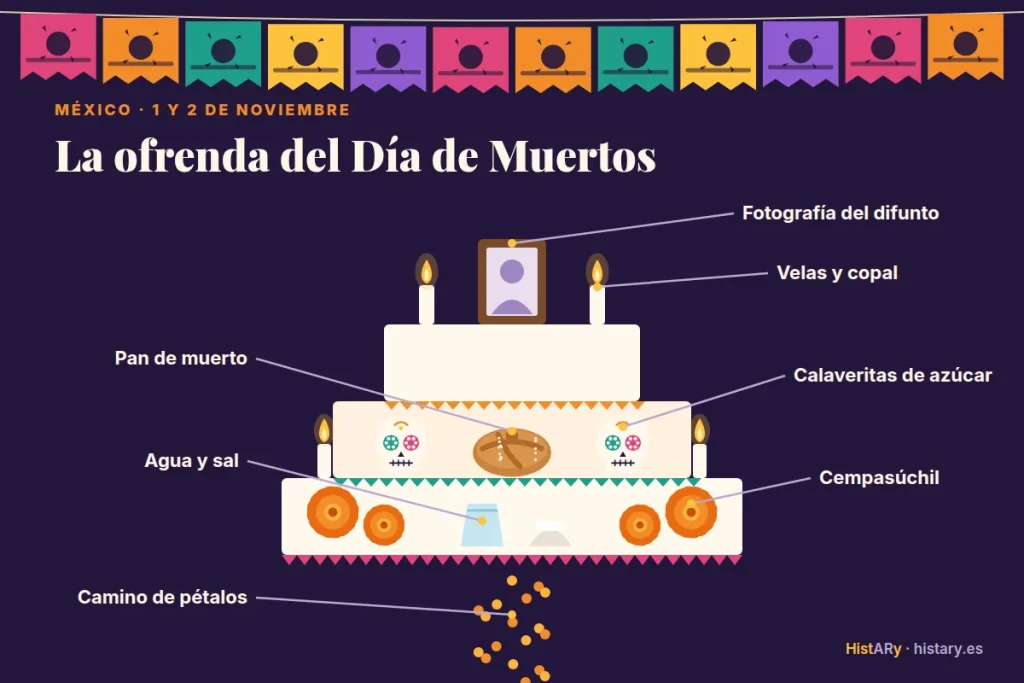
The offering is the heart of the celebration. It usually includes:
- Marigold, the orange flower whose color and aroma guide souls.
- Candles and copal, to illuminate and purify the path.
- Water and saltWater quenches the thirst of the journey and salt purifies.
- Bread of the Dead and sugar skulls, with the name of the deceased.
- Confetti and photographs, so that the visitor feels at home.
La Catrina: from social satire to global icon
The most famous figure of the Day of the Dead was born as a critique. In 1912, the engraver José Guadalupe Posada drew The Garbanzo Bean Skull. With it, she mocked those who denied their indigenous roots to imitate European fashion.
Years later, in 1947, Diego Rivera dressed her up in his mural Dream of a Sunday afternoon in the Alameda Central. He also gave it the name by which the world knows it today: La Catrina.
And a fact to surprise your classmates: Mexico City's grand parade was held for the first time in 2016. It was born after the film Spectre, The James Bond film, in 2015, featured a parade that didn't actually exist. That time, life imitated the movies.
Halloween and Day of the Dead on the table: three countries, one same bread
If there's one thing that unites Halloween, Day of the Dead, and Castanyada, it's food. In all three countries, a sweet treat serves as a bridge between the living and the dead.
| Country | Key date | Party | Sweet | Symbol |
|---|---|---|---|---|
| Mexico | November 1st and 2nd | Day of the Dead | Bread of the Dead | Marigold and Catrina |
| Spain | November 1st (October 31st in Catalonia) | All Saints and Castanyada | Saint's bones and panellets | Flowers in the cemetery and chestnuts |
| United Kingdom | October 31st and November 5th | Halloween and Bonfire Night | Soul cakes (historical tradition) | Lanterns and bonfires |
The ingredients change, but the idea remains the same: to share something sweet with those who have already passed away.
What is the difference between Halloween and Day of the Dead?
It's the question we hear most often on school tours. The short answer can be summed up in one sentence: Halloween disguises itself as death, and the Day of the Dead invites it to dinner.
- Halloween It plays with fear. The costume was born to confuse spirits and today it's pure fun.
- Day of the Dead It celebrates the reunion. It doesn't seek to frighten, but to remember with affection and joy.
- All Saints It's a day for reflection. It's a day for visiting the cemetery and remembering family.
That's why it's important to explain to students that Catrina makeup isn't just any costume. It's a symbol with over a century of history behind it.
Halloween and Day of the Dead in the classroom: three challenges before traveling
If your group is traveling to Europe in the fall, try this activity to talk about Halloween and Day of the Dead in class. It works really well before departure:
- The bread challenge. Compare the bread of the dead, the saint's bones, and the soul cakes. What ingredients do they share, and what does each one mean?
- The costume challenge. Why did Scottish children dress up? How is it similar to and different from La Catrina?
- The challenge of the place. Choose a cemetery or monument in London, Barcelona or Madrid and discover the story it holds.
So, when they arrive, they won't just see streets and buildings. They'll see stories.
Autumn study trips to Europe: what your students will see
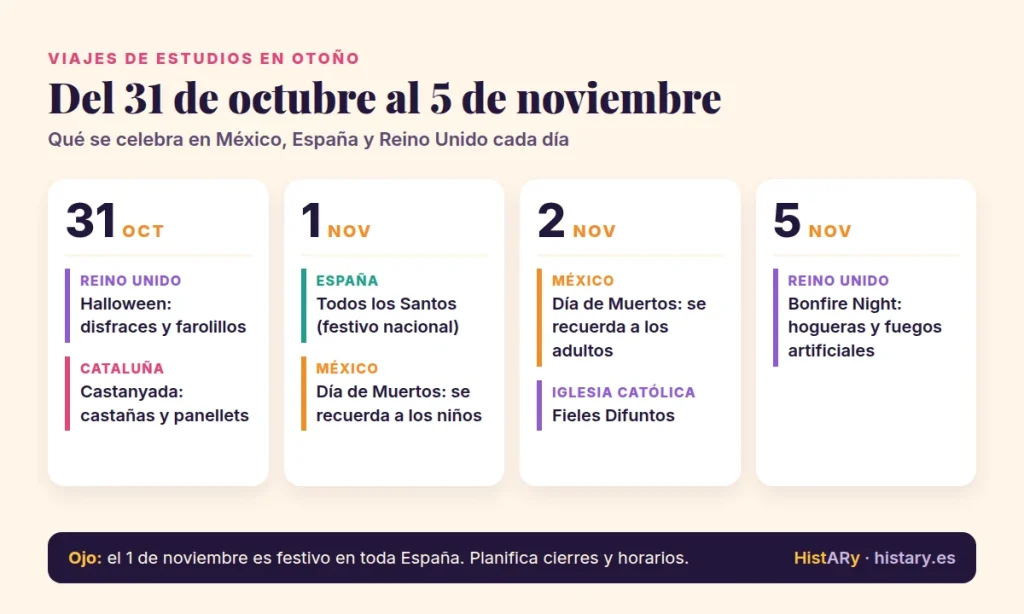
Traveling between late October and early November has its rewards. Between Halloween and Day of the Dead, history is literally on the streets:
- October 31st in Barcelona: chestnut and panellet stalls in every neighborhood.
- November 1st in Spain: It's a national holiday, so it's best to plan opening times and closing times in advance.
- November 5th in London: Bonfires and fireworks for Bonfire Night.
At HistARy, we transform those dates into experiences. Our tours combine a guide who is both historian and actor with augmented reality on mobile devices. This allows students to see what each place looked like centuries ago, without any extra hardware or changes to the itinerary.
We work in London, Barcelona, and Madrid with school groups from Latin America. You can also see our full proposal for schools at [link to proposal]. School tours with humor and augmented reality.
👉 Do you coordinate study trips? Request a 15-minute demo and we'll show you how it fits into your itinerary.
Because history, like the dead in November, always returns. And when it returns with humor, no one forgets it.